35 years ago today, on October 5, 1991, Linus Torvalds announced Linux 0.02 in a post to the comp.os.minix newsgroup (full post):
From: torvalds@klaava.Helsinki.FI (Linus Benedict Torvalds)
Subject: Free minix-like kernel sources for 386-AT
Date: 5 Oct 91 05:41:06 GMT

... It is just version 0.02 (+1 (very small) patch already), but I've
successfully run bash/gcc/gnu-make/gnu-sed/compress etc under it.
A few weeks earlier, on August 25, he had described it as “just a hobby, won’t be big and professional like gnu.” It turned out a little bigger than that. :-)
I started using Linux around 1995, so I’ve been along for about 31 of those 35 years. That’s a little hard to believe.
My career has taken me through enterprise software, distributed systems, big data, cloud, containers, machine learning, and now AI and LLMs. The technology has changed dramatically.
Linux has been there through pretty much all of it.
It started around 1995
I started experimenting with Linux at university, and using it back then was quite different from using it today.
One of my early memories is getting a new piece of hardware - a sound card, a mouse, a network card - and realizing that plugging it in was only the beginning. Sometimes getting that hardware working meant configuring and recompiling the Linux kernel with the right drivers.
Configure the kernel.
Compile it.
Install it.
Reboot.
And hope. :-)
If the machine came back up and the new hardware worked - success! If it didn’t, figure out what went wrong and try again.
It sounds painful by today’s standards, but I learned an incredible amount this way. Linux encouraged me to understand what was happening underneath the operating system - hardware, drivers, filesystems, processes, networking, shells, compilers.
I wasn’t just using the computer.
I was learning how the computer worked.
The distro CD days
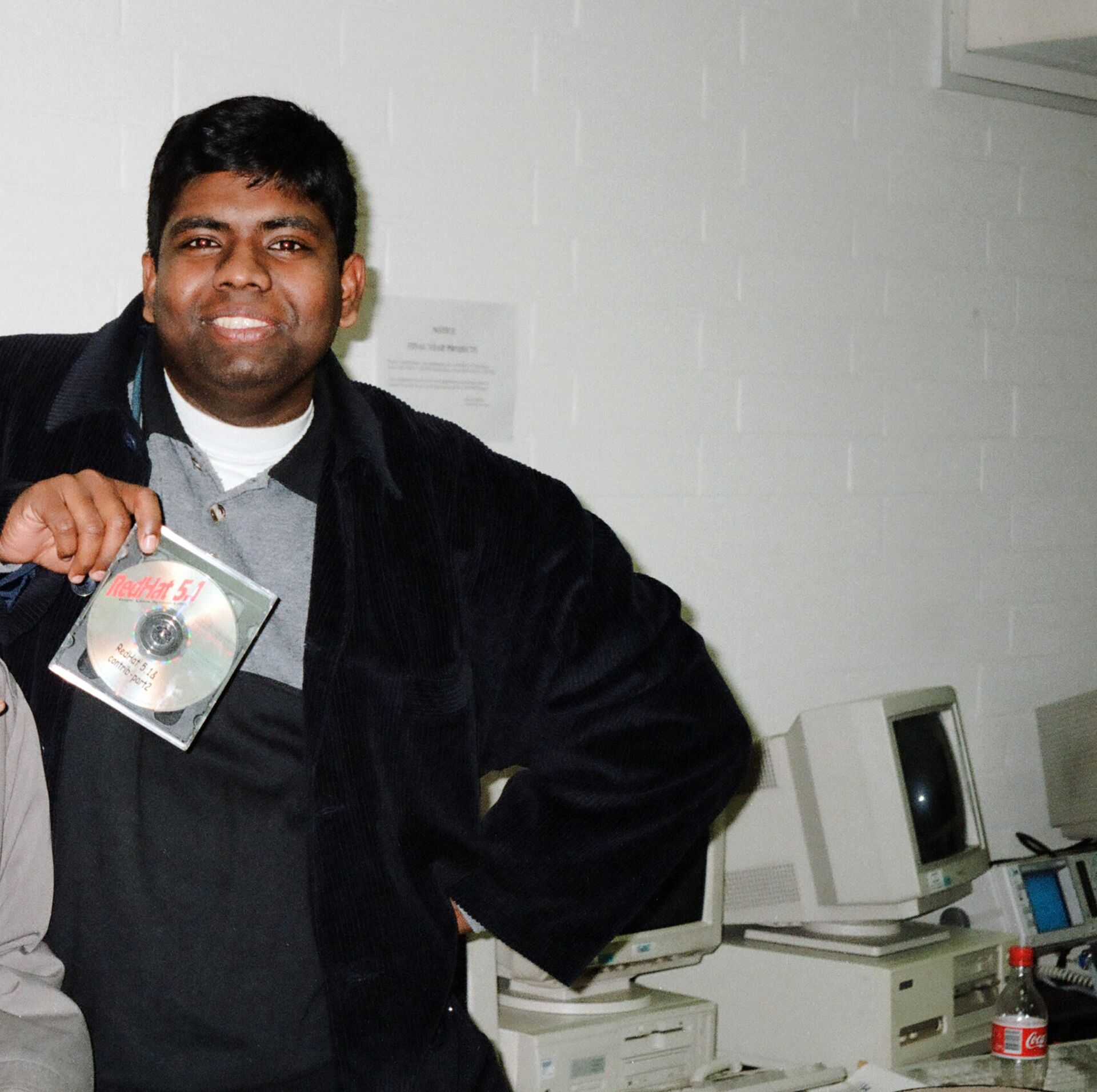
Me holding a Red Hat Linux 5.1 CD, circa 1998. Check out those CRT monitors in the background!
I recently found this old photo of myself holding a Red Hat Linux 5.1 CD.
Yes, Linux came on CDs. :-) I remember going to computer swap meets to pick up distro CDs.
I love everything about this photo now - the CD, the CRT monitors, and of course the empty bottle of Coca-Cola, still my favorite source of caffeine today!
I certainly didn’t imagine I’d be looking at this photo nearly three decades later, writing about how important Linux became to my career.
LinuxWorld, 2001
Then I found another photo in the archives.
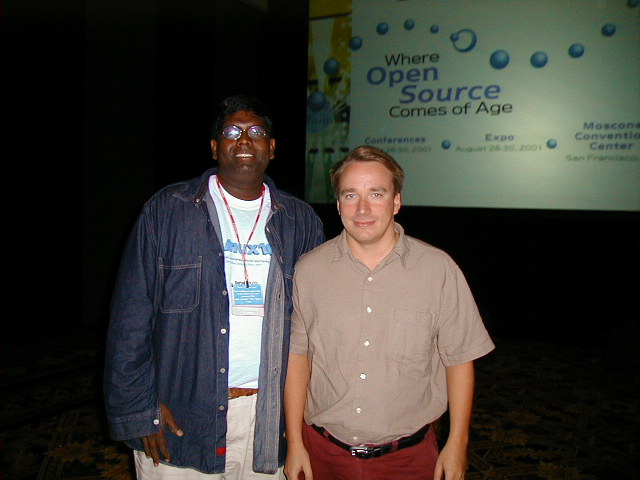
A photo with Linus Torvalds at LinuxWorld, 2001.
I attended LinuxWorld that year as a Linux and open-source enthusiast. I particularly like the backdrop:
“Where Open Source Comes of Age.”
That was 25 years ago.
35 years of Linux
Linux began in 1991 as a personal project by Linus Torvalds. October 5 is one of several important dates in its early history: Linux 0.01 appeared in September, and on October 5, 1991, Torvalds publicly announced Linux 0.02.
What followed is pretty remarkable. Linux grew from an operating system for enthusiasts into something that powers servers, supercomputers, embedded systems, cloud infrastructure, containers, and today’s massive AI clusters.
To mark 35 years since Linux 0.02, I created this short animated history of Linux.
Linux followed me through my career
My career has moved through several generations of technology:
- Java and enterprise software
- Big data and distributed systems - Hadoop, Spark, Cassandra, Kafka
- Cloud and containers - Docker and Kubernetes
- Machine learning and deep learning
- And now AI, LLMs, inference, and GPUs
Very different eras of computing, but with a common thread:
Linux.
From compiling kernels to running AI models
Here’s my favorite part of the story.
Thirty-one years after I started experimenting with Linux, my primary workstation still runs Linux.
Today it’s Linux Mint, with an NVIDIA GPU for running AI models locally.
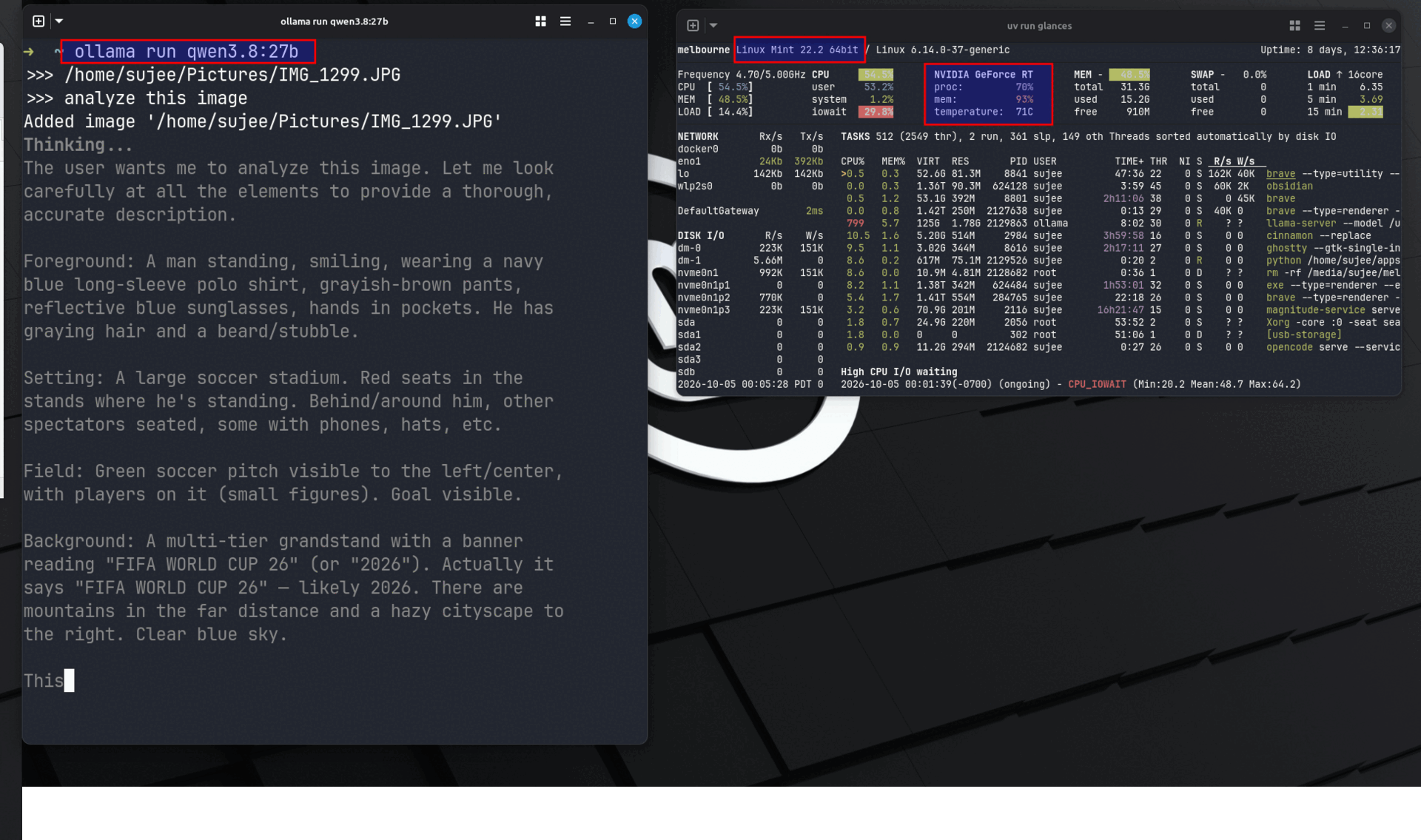
My Linux workstation in 2026: Linux Mint + NVIDIA GPU, running an AI model locally with Ollama.
I love the contrast.
1995: Get a new sound card. Recompile the Linux kernel to get the driver working.
2026: Run an AI model with billions of parameters on an NVIDIA GPU sitting under my desk.
The hardware has changed.
The workloads have changed.
The tools have changed.
My career has changed.
Linux is still there.
More than an operating system
Linux was more than an operating system. It showed me the power of open source.
Anyone could inspect the code, learn from it, change it, break it, fix it, and contribute back.
That cycle - explore, build, break, understand, fix, contribute - shaped the way I learned technology. It still does: the technologies have changed over the years, but I’ve kept using, contributing to, and learning from open-source projects ever since.
Happy 35th, Linux!
Here’s to many, many more!
P.S. How I made the video
There’s another story behind the Linux history animation.
I created it using Claude Code as part of an experiment around “video as code” - keeping the source, prompts, assets, and rendering workflow in Git, and treating the final video as a generated artifact.
That’s a whole other rabbit hole :-) - I’ll write about it separately.
A note on AI: I used AI as a writing and coding partner to help organize my thoughts and polish this article. The stories and memories are mine.